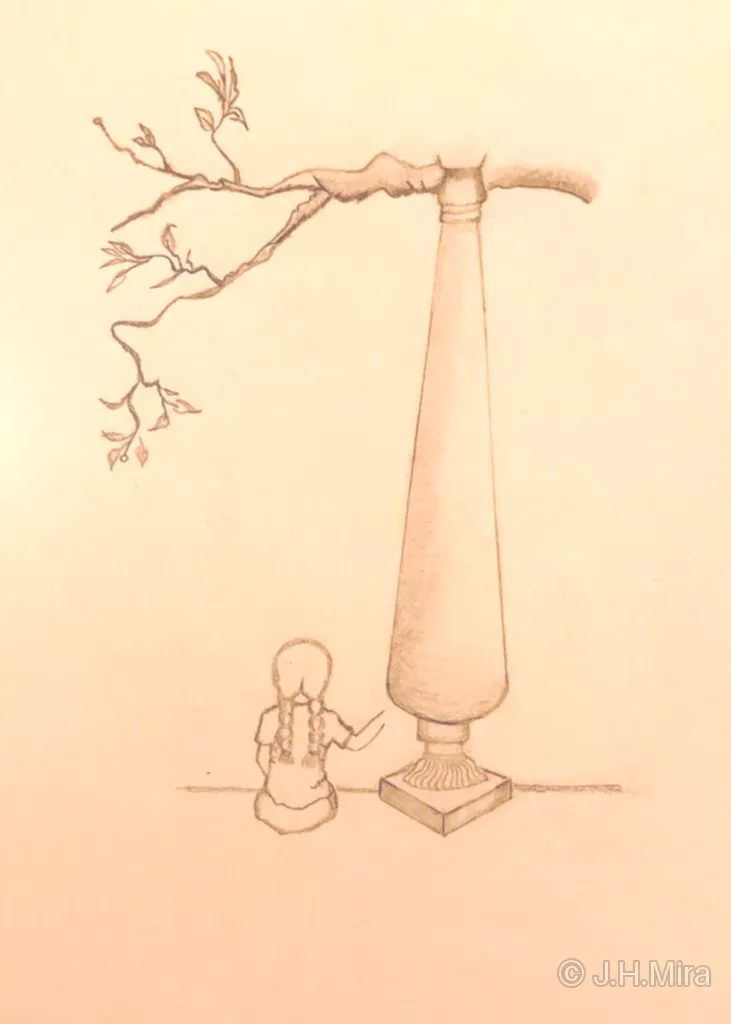
The dark decay of her teeth adorned the hollows of her mouth, casually, like icicles hanging off eaves on a cold wintry morning. Vasu was on board the Dadar Express, examining the singularity of her dental status in its tiny washroom mirror. Standing lifted on her toes. Looking for a change of countenance. There was none. She looked at it not with the concern of thought but merely with the appeal of diversion, a tendency of habit to investigate her most distinguishing feature. 'Puchipallu Bombaikaari' (the Bombay girl with infested teeth) she thought, as her maternal grandfather used to tease her, running her tongue along the jagged edges of her mismatched incisors. The staggering sight did not bother her. Vasu was eight. A lot of things did not bother her.
Her mother, who stood outside keeping guard, knocked softly on the door. Vasu did not open it right away. Instead, she watched the train in motion through the toilet — a travelling, gaping hole in the floor, on its way to a river town.
It was summertime, and the family were on their annual visit to their small ancestral hometown, Keelakollathur, along the banks of the Agniar. It would take them an entire day and a half by train to get there. A southward journey filled as much with sliding lusty fields as with great green groves. Smudged cottage bundles punctuated the unbidden greens. Bursts of barren land, thirsty and brown, passed unceremoniously between lesser towns.
Stretched out on the lowest blue vinyl berth, next to her older twin brothers, Vasu gazed out of the barred train window, thoughtfully, in anticipation of the coming respite. She recalled the coconut grove noons with cousins, first and second. Connections that start tender. Loving aunts who had breastfed her like one of their own. Towering uncles with sprawling moustaches, who on their Sunday market rounds had rendered delightful shoulder rides and joyful sustenance for the heart and hunger. And most of all, visions of sumptuous repasts that all of the town had known and loved — for Aachi’s tempting genius in matters concerning feasts and festivities, whether innate or cultivated, stood peerless. Even as she thought, Vasu's mouth watered for the far joys of the simpler, charming kind.
On the bunk opposite them, Selvam, Vasu’s father, a tall, erudite man, sat subdued, smelling faintly of woody aftershave and cigarettes, moving gently in obedience to the train’s rhythm. His head was buried in a massive book bound in stiff red cloth, which held within it a few ripped pages, torn in an act of remonstrance by his young beauty of a wife. His intellectual pursuits, distinct as they were, gave her no pleasure, for she was simple of mind and quick of emotion.
Brisk to anger but consenting to calm, Amutha, Vasu’s mother, was one moment a thunderstorm with a wicked temper. Slamming doors. Blurting out barbed rebukes that came loose and easy. And happy rooms lay bruised with broken cups and books flung wide. And the next, the most amiable creature of euphonious sounds. All charm and all courtesy. Amutha was only seventeen when she married Selvam. Her own youth and inexperience had made her pointedly aware of his acquired knowledge, his insight, and his foreign ideas, all of which had filled her with wonder. She had fallen hopelessly in love with both his form and his novel inclinations.
On their wedding day, Rasambaal, one of Amutha’s great-grandaunts, who had been particularly fond of her, had expressed her disappointment at the arranged alliance quite bitterly. 'You raise a parrot and give it away to a cat just when she sprouts her first set of innocent plumes. Such blunder. Such blunder!' she had cried. She had said this not to call attention to her own rank or dignity but rather to confirm the distinction of their years, temperaments, and conditions. For as the eldest, she possessed the wise, pragmatic sense for weighing facts and realities too often neglected in favour of fixed ideas and deeply rooted rules.
He, a thinker from quite another corner of town. A corner where many tread. From the weary feet of farm-help to the leisured steps of silk merchants. From fishwives at dawn to jewel-sellers at noon. From toiling maids to ready mistresses. And out of it all, he — with the will and labour that alter chance, integrity and character that command respect, grace and education that order natural authority — had found rising fame in superior society.
And she, the great-granddaughter of a great-grand Zamindar. A budding goddess with beautiful eyes. Blossoming in delight and dignity under watchful attendance. Her shadow had not yet journeyed beyond her mother's saree pallu. The act of marriage between these unlikely two had struck Rasambaal as hasty, promising grave discontent. The family had heard her, and gone on with the wedding.
Selvam, not long after the wedding, had started calling Amutha secretly 'The Green Parrot' — the parrot who now sat next to him by the train window, offering the children banana chips and coconut biscuits from a fancy tin, yellow and round.
Like most small-town girls her age, Amutha had been groomed to be a devoted wife and mother. In all her tens and teens, it had never occurred to her to see herself as anyone else. She had pursued her conditioned calling with remarkable dexterity and pride. To her husband at home, she was his lady-in-waiting, attending to his every notion and necessity. To her children, she was a spirited mother. They were measured and monitored. Trained and tutored. Oiled and massaged. Dressed and dewormed with assiduous attention. To her friends, she was too dear. To her they confessed their hearts and hopes, their troubles and trifles, their most delicate doubts, and their crushing convictions. To them, she had become a source of great comfort and relief, a caring and sympathising figure, and to her they granted their affections cheerfully and in full measure.
Yet with all of this, Amutha had often felt ruin — in her husband's profuse use of time on matters of philosophy, in his greedy appetite for books, in his recent renunciation of meat, and in his sharp disinterest in all things condemned as social and ordinary. It had happened gradually, the weakening of the convictions she had earlier gained. The culmination of years of contrasts that had manifested between the two had led to the dissent of her own agreement, in the most prosaic manner.
It had been sometime last spring. After much persuasion, Amutha had convinced her husband to go to the cinema with her. 'Ek Duuje Ke Liye', the 1981 blockbuster, a romantic tragedy. She had arranged for the tickets beforehand through friends. Worn one of her special-outing chiffon sarees. Darkened her eyes with kohl. And painted her lips a ruby red. She had looked terrific. He had said so himself. They had arrived at the theatre looking fashionable and had sunk into their good seats with the freshly buttered popcorn and the sparkling bottles of Limca. Twenty minutes into the movie, somewhere in the dark, a low rumble had started to sputter to life. Someone hissed 'Shhh'. Then came another, right next to her, louder than the first. Heads turned. Shoulders stiffened. Complaints whispered. Irritation had begun to travel restlessly in the dark. She had turned to find him deep in sleep, snoring loudly without care or regard — killing the experience for everyone around them. The displeasure was made known to her so promptly, in a manner so cutting that she had to repeatedly pinch or elbow him awake. She had stormed out of the theatre halfway through the movie, with her disconcerted husband tumbling behind her. Never more aware of the steep difference in their interests and age, she had found herself, somewhat to her own surprise, guarded against giving in to the rollicking reproach that bubbled at the edge of her tongue.
At other times, in house parties and such, when she and others were in high spirits, disposed to gaiety, lively in the pleasures of congenial society, Selvam would choose, quite innocently, to discourse on the path of spiritual transcendence or relative consciousness or some such undesired and out-of-place matter. His conduct, indecorously off-putting as it was, would send most guests scrambling out of his view, and would invariably earn him their faulting perception of a 'party killjoy'. Amutha, at such times, sensed the disparity between their minds and moods growing beyond recovery. Past help or hope. Like a broken kite lost to the dark monsoon winds.
Fresh judgements grew old. He, still himself. She, no longer.
And though the initial admiration for her husband’s instincts and sensibilities still thrived in her heart, his growing appetite and zeal for affairs beyond her appreciation caused her much grief. Leaving her feeling unanchored. She had started, diligently first and monstrously later, praying to her gods. Visiting temple after temple. Keeping fast. Performing rituals. Beseeching a remedy for this confident, handsome man to become simpler, more manageable, more like her, and more for her.
She looked at him now, sitting next to her on the train, the strong straight of his nose. His fingers, long and delicate, absentmindedly felt the strays of the morning shave on his chin. His eyes engaged with the distant pages of a massive red book that she instantly recognised from her own not too distant past. It had been in the late morning, sometime in early June. She remembered walking to the green bookshelf in the living room, reaching for the newest-looking book she could find, and tearing the pages out — one at a time, slowly. Her fists clenched, full of keen displeasure and firm intentions. She had put the torn pages back into the book and waited for it to be found. For her husband to bring it up, ready for a quarrel. But he hadn’t. Instead, he had spent the evening quietly mending the pages, played Scrabble with the children, and gone to bed early without dinner. The loss of attention had left her immensely bothered.
'Don't sit too close to the window, Vasu. Coal dust will fall into your eyes,' warned Mrs Pillai, the chubby, chatty passenger on the side berth across the aisle. She spoke with the familiarity of an overbearing aunt who had known Vasu from her early crib days, instead of the reserve of a fellow traveler whom she had just met. But it was not new for the children to be regarded so closely, to be chaperoned by well-meaning companions, for strangers on buses and trains to become aunties and uncles at a moment’s notice. They were accustomed to suffering such interferences. And they did so, the twins with patience, polite manners, and tolerant smiles, and Vasu through clenched teeth, held tongue, and simmering resentment.
Mr and Mrs Pillai were travelling back from the city after having attended their daughter’s graduation. Mrs Pillai spoke often, confiding old-time stories to Vasu’s parents. And when the parents were unavailable, she would target the children, asking them all kinds of frivolous questions. She seemed to be the kind who was determined to augment the fugacious webs of train travel familiarity with words, and much of them. She would only take short breaks from her incessant jabber to drink water from her shiny brass kooja or to feast on all kinds of homemade food that came out of her seven-tier tiffin box. Careful to ward off any ill feeling, she always offered the eatables to the children but never to the parents. Her husband, on the other hand, appeared discharged and paid no attention to her chatter. He hid behind newspapers and took conveniently long naps, cleverly aimed at exempting himself from the labour of participation.
When Vasu became the point of Mrs Pillai’s interest, of her relentless banality, she refused to speak. She pressed her lips tightly together, shook her head from side to side, and looked suitably distressed, hoping to be ignored. 'What happened?' Mrs Pillai finally asked her, flustered.
'Teeth black no talk,' announced Vasu tragically, pointing to her icicles.
Undeterred by this petty opposition, Mrs Pillai simply rolled her eyes, huffed her disapproval like a teapot, and moved on to her twin brothers.
Few escaped Mrs Pillai's ripe faculty of engagement — not the hawker, not the chaiwallah, not the coolies loading trunks, no one. If one of them was to approach her with the prospect of a quick sale, he was bound to find himself given to her prying curiosity. On one such inquiring exchange, a gawky, dust-streaked fifteen-year-old succumbed to the gentle tyranny of her words. Perhaps it was just out of fellow feeling. Perhaps it was the hope of advantage from someone of superior means. The boy went on to disclose the tragic details of his wretched life. An ailing, bedridden mother. A married sister returned for not having borne a son. And an ancestral debt of crushing proportions. All of which had forced the poor lad to surrender his school and take up the lowly drudge and strain of the Velankanni station.
Upon hearing the boy’s catalog of ruin, Mrs Pillai seemed deeply touched and shook her head in solemn reflection. She fumbled into her straw basket as if looking for a rescue and came up with a brown leather moneybag that held the glorious promise of the much-anticipated support.
The boy, who had been hoping for precisely some such relief, stood on the platform in front of her window with folded hands, looking humbled and grateful, his keen eyes fixed on Mrs Pillai’s bulging moneybag. Out of the mouth of the brown moneybag, Mrs Pillai pulled out a tiny book of Hanuman Chalisa, which she then handed to him through the barred train window. She told him that if he chanted the mantra three times a day, he would receive salvation from all his worldly vexations and would be driving a Benz on the Mount Road instead of hawking meduvadai from a tray strapped to his neck.
Her solemn advice was rudely interrupted by the blast of a steam trumpet announcing the departure. The train began to snail out of the railway station. People inside the train rushed about to settle into their seats. Suddenly, an unexpected movement caught the attention of passengers in Vasu’s compartment. It was Mrs Pillai’s small book that had come flying back through the barred window and landed squarely on the train floor.
The tiny audience looked from the book back to Mrs Pillai and found her a flushed flamingo of indignation. Her arms crossed over her chest. Her mouth open against her will, as if to cry out loud. Her eyes turned questioning. Her fine features twisted comically with part shame and part disbelief. Her big red bindi loomed precariously between her strained full eyes. Behind her, the platform slipped away as the train gained pace. She continued to stare at the book on the grimy train floor. Conflicted. Trying to make sense of the retaliation. The unexpected protest.
Before Vasu’s chuckle could gain vocal tone, her mother shot her a sharp look, the kind that came when the candy jar turned up empty under Vasu's bed. Her twin brothers, having witnessed all that had taken place, studied Mrs Pillai’s return to her chastened self with great interest. Meanwhile, Vasu’s father bent over to pick up the 'Hanuman Chalisa' and handed it to Mrs Pillai. She accepted it without a word.
Mrs Pillai recovered quickly, betraying no further emotion. To everyone’s delight, she resumed the rest of her travel in restrained silence. When her husband finally surfaced from behind the newspaper and asked her if she was all right, she simply nodded, despite all evidence to the contrary.
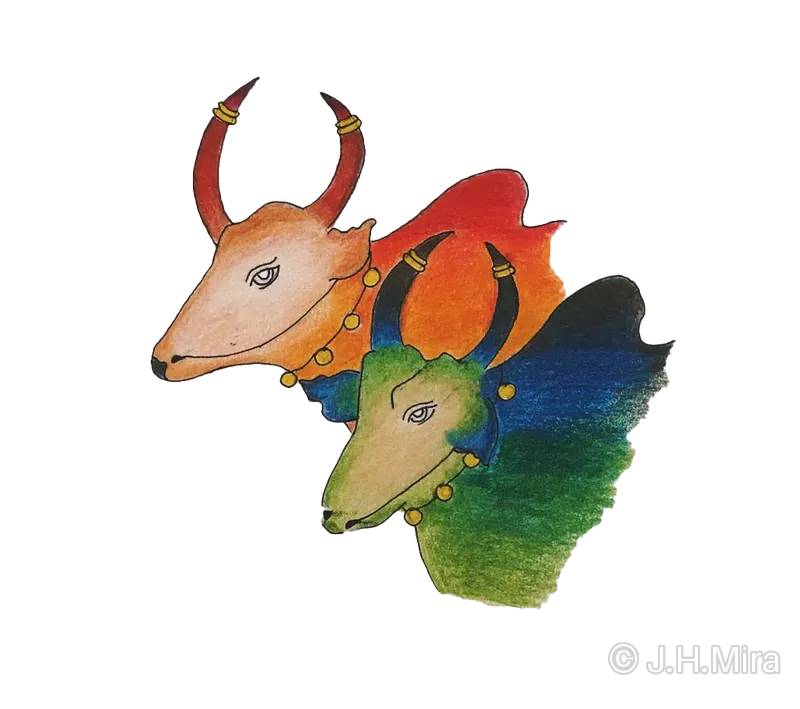
The family arrived at the Keelakollathur station to the early blended sun. The morning chill lunged at Vasu as she got off the train, making her shiver. Tiny trembles tumbled down the small of her back. Little brown fingers sought refuge, curled and tucked under a knitted willow jumper. The railway platform stood deserted, but for a lone sweeper and the stationmaster — a dull, middle-aged balding man, who proceeded to flag the train through. The children watched the train roll out, gold in floating dust and shy light. Across the tracks, a clump of thatch-roofed houses worked up sooty spirals. At Keelakollathur, all things smelled of woodsmoke, wet earth, and cow barns to them, comforting and native.
A bullock cart had been arranged for their transport. Ramaiyya, the househelp, stood at the station gateway wrapped in an old blanket coarse with use. He had been acquired at the age of ten in a game of bridge, by victory over the village tahsildar. The sorrowful inheritance of a misguided practice. He had served the family over generations, during which he had earned the warmth of his master. Gained concessions and liberties seldom offered to the help. And was even granted a small parcel of land, of considerable value, not far from the main house. But had never slackened in his heavy sense of obedience and spent his time wifeless, serving the Zamindar and all his seven children. To Vasu, Ramaiyya had appeared cheerful and unchanged. To others, he had appeared desiccated by daily duty. His skin flagged. His back bent. His hair, though, had magically remained untouched by the seasons, as if it belonged to someone else, someone decades younger.
The oxen piled with the outsiders and their luggage slogged along, snorting their reluctance to leave their resting place by the wayside tamarind tree. Vasu sat on the back of the cart with her mother and father. Her two brothers sat up front with Ramaiyya, delighted in their privileged view. Ramaiyya whipped the bullocks to a faster rhythm reminiscent of a familiar pattern of prior pleasures. The scented native air, sweet with the freshly turned wet soil. The riotous display of intermittent passing greens. The sight of men and women planting ankle-deep in murky waters. And the palm-breeze rustle, blowing east, coloured pale memories bold.
The happy oxen bells announced their arrival to all, inviting the curious attentions of a grocer caught in the middle of weighing his merchandise. The village barber. Men in lungis reading the paper that tarried all morning at the local tea stall. And a few other inquisitive heads that peeped out of open windows and pried behind busying pursuits. The outsiders, unaware of the sneaking interest, made their way home bumping gently along the old dusty route.
The bullock cart came to a sudden halt in front of tall iron gates. The stone compound walls seemed more swollen than Vasu remembered. The bougainvillea had spilled over, weaving pink and white blooms into the ground. Leaving the cart at the main gate, Vasu and her family walked past the trees lining the long driveway, upright old guards looking down upon them with their thick neem limbs spread under the climbing sun.
Vasu’s grandfather stood at the entrance of his grand old home with the quiet dignity of an old king surveying his realm, waiting for the children. Having caught his imposing form, they bolted towards him squealing with excitement, leaving their parents behind. Unrestrained. Vasu ran hard, her little feet stumbling way behind her brothers, who to her seemed far and fast. She watched her grandfather swoop them up into a tight embrace, plant kisses on their grimy cheeks. She heard her brothers at the top of their voices, each eager to compete with the other to hold his attention. Her grandfather’s big throaty laugh, roaring and crumbling into a settling smile. The fuzzy, spirited chatter turned back into the majestic house, slowly fading out of her vision and hearing.
By the time she made it to the porch, her little heart burnt with labour, on fire inside her little chest. Vasu sat, catching her breath against the giant carved column that flanked the entryway, waiting for her mother and father. Impressions struggled. Exaltation soon faded. And a troubled head turned to watch her grandfather’s full silver head disappear down the long verandah into the inner courtyard carrying his grandsons triumphantly. Their entitled arms wrapped around his collared neck.
The seemingly innocuous incident left her to sense a new kind of smallness. A strange sentiment revealed without meaning to, revealed without reserve, candidly, in the most ordinary way. The order of affections. Sons before daughters. Heirs before others. The denied consent to love him brimmed her eyes with wet realisations. The inattention to the bounty of a child's eager affections seemed to draw the objection of the breeze itself, having stilled down a measure. Even the old neem guards along the beaten driveway appeared less alive, sounded less clamorous, as if to mark the discourtesy.
At the sound of her mother, Vasu flew to her feet and threw herself at her, hugging her dearly. And though she did not say a word, she could not quite conceal her rapidly mounting sadness, which found its proper conclusion wrapped up in her mother’s arms. And there under the delicate shadows of the flowering Athimaram and the blue moving sky, a mother’s warmth and a father’s sonorous soothing concern made up for a grandfather’s remiss. The black frost that threatened to damage, before its time, the little innocent heart, now lay melted in a pool of tears and mucus.
Wedged between her parents, Vasu stepped into her maternal ancestral home and walked down the long verandah into the inner courtyard towards the welcoming sounds, with no impressions of having arrived. The house, in turn, welcomed her, knowing full well that tomorrow’s sun would blur the ways of today. Its lucidity denied to her beyond her next distraction. An act of kindness, afforded by the fleeting habits of tender age.